Showing posts with label feminist. Show all posts

Wednesday, 24 June 2015

a letter to three wives

a letter to three wives is an oscar-winning film from 1949 that i’d never heard of until recently. there’s a newsreel clip on the dvd that shows part of the oscars ceremony from that year and i’d never heard of any of the films that won, which makes me wonder how many great films i’ve never heard of and whether the oscars are really that important anyway. mostly i’m just glad i got to see this film at all, because it has interesting women doing stuff and dealing with issues in a way that's often missing from contemporary films.


the film follows the titular three wives on a day trip with a group of school kids. before the boat leaves they open a letter from their mutual friend, addie ross, in which addie declares that she is going to run away with one of their husbands that day. away from the mainland and with no way of contacting their husbands, all the three wives can do is each reflect on their marriages and wonder if it’s their husband addie has stolen.


a letter to three wives is a comedy-drama, although i’ll be honest, i didn’t realise it was supposed to be a comedy until one of the jospeh l. mankiewicz biographers mentioned it on the commentary track. sure, there are funny moments but i wonder if the definition of  ‘comedy’ has changed over the years. it doesn’t really matter, because it’s the drama that’s interesting here.

the three main characters seem bold and interesting by today’s standards but whether that’s a reflection of a forward-thinking writer/director or a sad indictment of the decline of gender representation in contemporary cinema, i’m not sure. the least interesting character is probably linda darnell’s gold digging lora mae, and yet her character has the most complex relationship with her husband. she’s more than just a gold-digger, that’s the point, and her later scenes with paul douglas provide some of the more surprising and touching moments in the film.


then there’s ann sothern’s rita, a radio writer who has shot to fame and made a fortune from her career. the issue is that her husband, played brilliantly by kirk douglas, is a low-paid schoolteacher at a time when it was unusual for the woman in the relationship to be the breadwinner (to be honest, sometimes i think that’s still considered unusual, even if it is more common these days). ultimately, it’s not douglas’ character who has an issue with this, it’s rita who wants to bring him up to her level without understanding that money isn't all that important to him. in this way, the film becomes a real study of class and status, but rather than simply playing that out between the couples, the difference between the classes is more prominently represented between the individuals in the actual relationships.


this is most evident with jeanne crain’s deborah, a woman who met her husband while serving in the navy. many films of this period tackled the subject of soldiers returning from war only to struggle to fit back into society, but few of those films chose to focus on a woman in that situation. it would have been particularly difficult for women returning from war because suddenly they were expected to go from a position of authority and activity back to being housewives again, a predicament that was highlighted in betty friedan’s seminal 1963 feminist text, the feminine mystique. in deborah’s case, the difficulty of fitting back into society is made worse by the fact that she is also a small-town farm girl thrust into middle-class society because of the man she met in the navy.

all three stories here are equally interesting and thought-provoking, helped by mankiewicz’ assured direction which keeps a steady pace and gives the ideas room to breathe. structurally the film makes innovative use of flashback’s and narration to weave the various strands of the story into a compelling whole. but as great as mankiewicz is as a filmmaker, it’s the performers who really make this story work, particularly the darnell, sothern and crain.


a letter to three wives feels like a kind of film we don’t see too often anymore, certainly not among oscar-nominees. it’s a film where the stakes are domestic and the drama is familiar, and this makes it all the more emotionally charged. more than anything, this is an entertaining, accomplished film from a writer and director at the height of his powers working with a truly great cast, and for that reason alone it’s worth a watch.

eureka entertainment will be releasing a letter to three wives on blu-ray in a dual format edition as part of the masters of cinema series on 29 june 2015


Friday, 12 June 2015

forty guns

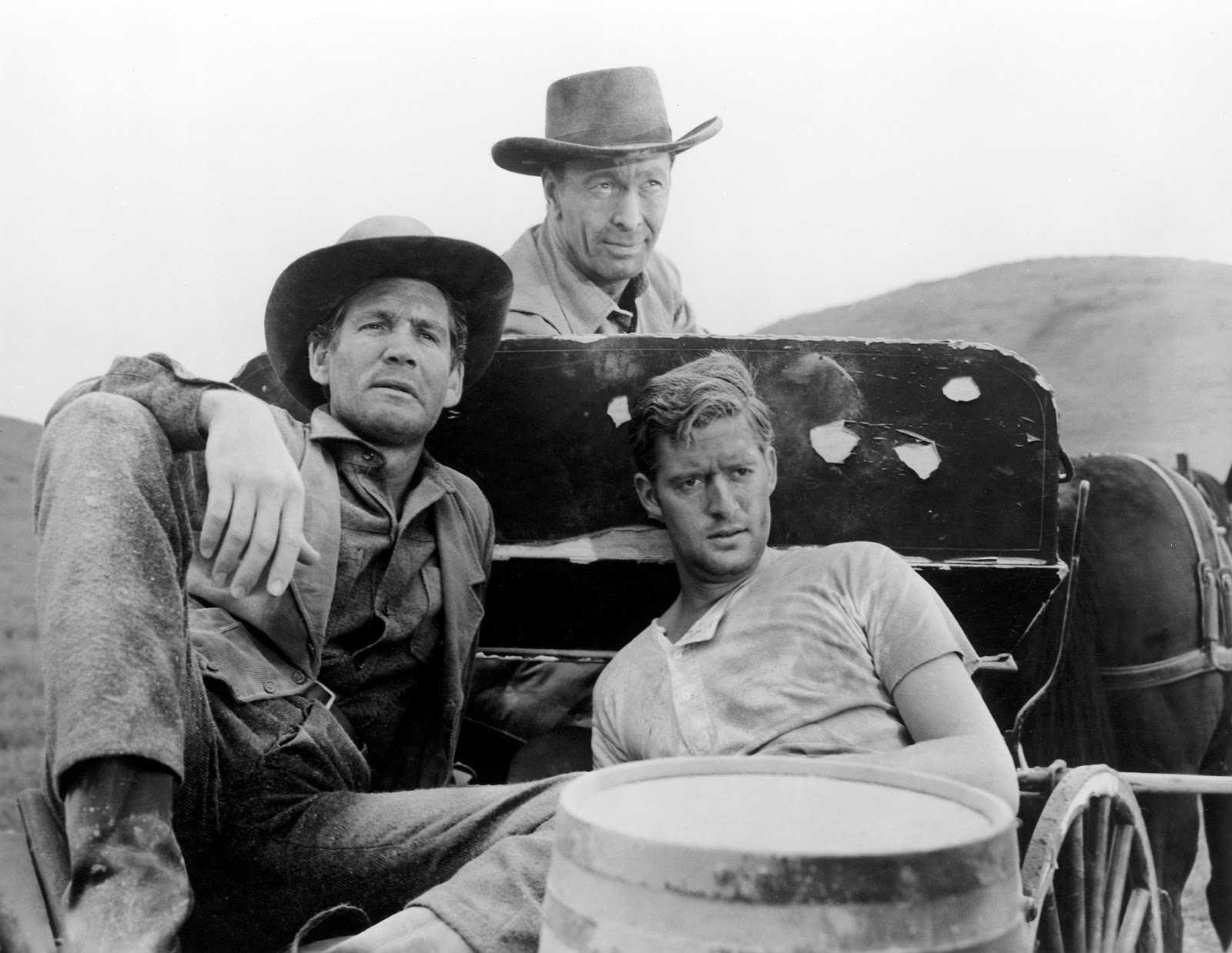
a lone carriage trundles across a huge, empty plain, its three passengers dwarfed by the vast countryside. in the distance a sound, like thunder. the three men look up, but what they see coming is not a storm but forty men on horseback being led across the plains by a black-clad woman with a whip. this is the breath-taking, iconic opening to forty guns and it only gets better from here.


jessica drummond (barbara stanwyck) is a wealthy and influential landowner who essentially owns the nearby town and the people who live there as well as her land and the lives of her forty henchmen. things are going great for drummond until gun-for-hire griff (barry sullivan) and his brothers wes and chico roll into town in search of an outlaw under drummond’s protection. but it’s not until griff has a run-in with drummond’s brother brockie that things really start to spiral out of control.


director samuel fuller has become legendary for his stylistic flair and he makes use of every opportunity to use it here. early on we are introduced to a blind sheriff and fuller makes us painfully aware of his condition by shooting some of his scenes in blurry pov. later he films a seduction through the barrel of a rifle. then there’s the moment where griff first confronts brockie; a symphony of cross-cutting and close-ups that really ramps up the tension. there are other stylistic choices too, like the moment chico first kills a man and then in the following scene appears wearing black like his two older brothers, the uniform of the cold-blooded killer.


fuller is equally adept at taking on huge technical challenges, like the scene in which griff and drummond are caught in the path of a tornado (also an excellent visual metaphor for their relationship). then there’s the scene in which the corrupt sheriff (dean jagger of white christmas and later vanishing point) sets griff up for an ambush. we watch jagger describe the plan with glee, and then fuller ramps up the tension once more in a suspense-fulled set-piece that would have impressed hitchcock.


fuller also wrote the script, which at its heart is a dark, unforgiving love story. drummond and griff are portrayed as lost souls, broken by their experiences and the things they have had to do to survive. there are moments in which it feels like they’re made for each other, balanced by moments where it becomes apparent that neither of them can exist in the same world. both stanwyck and sullivan put in great performances here and really sell the idea of two people haunted by their past lives.


there is one other element that really makes forty guns stand out. i’ve mentioned stanwyck’s entrance, and the film never holds back on portraying her as a tough, uncompromising leader forced to make difficult decisions. in a time when it feels like Hollywood is still struggling to break female stereotypes, fuller and stanwyck managed to do it in 1957. what really strengthens stanwyck's character is that she’s not portrayed as an anomaly; she doesn’t have a moment where she puts down the whip and admits that all she wants is the love of a good man (although to be fair, the film does come worrying close to that on a couple of occasions). drummond is what she is, and she’s also not alone. there is one other female character in the film, a local woman named eve. you would expect that the other female lead in the film would be portrayed as the opposite of drummond, a showgirl maybe, or a pretty farmer's daughter. instead, eve is a gunsmith and spends most of her scenes wearing overalls and talking to griff’s brother wes about guns. to have two such characters in a film would be considered progressive by today's standards, and perhaps the sad thing is that in 1957 i suspect it was closer to the norm. yes, dear reader, when it comes to gender equality in films we are moving backwards. forty guns is proof of that.


there is a little more to it than the female characters challenging stereotypes. though they are onscreen less than the men, the film often feels like it’s about women; that it’s telling a story about a woman’s struggle. there is a moment towards the end where drummond and eve meet and talk briefly about their respective tragedies. it’s the most dramatic, touching and real moment of the film and it sums up everything that’s happened in the story and everything that the film is about perfectly. unfortunately, this theme of women being left to pick up the pieces while the men play with guns doesn’t run through to the end.


i won’t spoil it here, but the ending was apparently changed from the one fuller wanted to go with. if you want my advice, stop the film after the last gunshot, you’ll know when it happens. if fuller had been allowed to cut there, this would be a perfect movie.

it’s worth mentioning that as with all the masters of cinema releases the picture looks superb and there are some really interesting extras including an insightful interview with french film critic jean-louis leutrat. not only will you see one of the best westerns ever made, you might even learn something too.

forty guns will be released on dvd and blu-ray by eureka! entertainment on 22nd june 2015


Tuesday, 20 January 2015

the thing (2011)

so i watched the remake/prequel of the thing and i didn't hate it.


although it's a remake in almost every aspect the film presents itself as a prequel, telling the story of the norwegian expedition that kurt russell and his mates find the remains of in the john carpenter version. i'm not going to do a plot rundown because if you haven't seen the john carpenter version of the thing you should really sort your fucking life out.

the prequel aspect actually worked quite well, in that the base looks really similar and some of the sets match like the room with the block of ice that the thing came from. the costumes and hair fit the period and i didn't notice any obvious inconsistencies, other than if you watched them back to back it would kind of be like watching the same film.

i thought the first half of the film was pretty cool. it was different enough to be interesting, and it actually harked back to the original howard hawks thing from another world in places (and yes, if you haven't seen the howard hawks version you still need to sort your fucking life out). but once the thing reveals itself it all goes a bit wrong. actually, wrong is probably not the right word, it's more that it felt like a missed opportunity, like they never quite captured the suspense and sense of mistrust that the original does so well.

but what makes this film work throughout is mary elizabeth winstead's performance and her character. much like the original, characterisation in this film is minimal so you never really find out where the characters come from or what makes them tick. i liked that, it was refreshing and it meant you never really knew any of the characters well enough to trust that they weren't actually an alien. but the one element that's played really well is winstead's paleontologist character being a woman in a man's world. there's a moment when the characters are discussing how to thaw out the creature and when she voices her opinion she's ignored, and then she's reprimanded for even having an opinion. this is balanced by the fact that there is another woman on the base so she's not the only woman in the world of the film. but the way she's treated fits the period and the environment and it really raises the stakes because she's the first to figure out what's going on but no one will listen to her.

then there's the fact that despite being one of two women, she's so outnumbered by the men and they're all so much bigger than her physically i couldn't help thinking there was a point to be made here. the carpenter version is a film about men mistrusting each other, and in many ways a closer modern remake would be something like tinker, tailor, soldier, spy. this film is about one woman mistrusting all the men.

let's take the alien out of the picture. let's say it's a film about a woman joining a team of men in an isolated area in the 1980s. would it play any differently? sure, there would be less flamethrowers and monsters and murders (probably) but would the tension and the mistrust be any different?

i don't know if it entirely works as a prequel, but i do believe there's more to this film than a carbon copy remake, plus it's cool to see a well-written female character be intelligent first and run around with a flamethrower second. for those reasons i think it's worth checking out.


Friday, 16 January 2015

husk

husk opens with a group of friends whose road trip is ruined when their car crashes next to a corn field with a spooky house in the middle of it (in the middle of the field, not the car). so far, so texas chainsaw massacre (i can't believe i just wrote that but i didn't delete it so i must be okay with it on some level). there are the usual archetypes - the chess team nerd (who actually uses chess to explain what's going on later in the story), the typical jock, his girlfriend, and a sketchy guy who is only sketchy so later on he can hotwire a car. and there's their other friend who runs off into the field immediately. based on that, it sounds like it should be awful, but it's not. it's actually kind of cool.


so what they soon realise is that if you're in the corn, something gets you. they end up stranded at the spooky house, surrounded by corn with no way to get back to the road. unless they can figure out what's going on.

what's going on is where the film get interesting, so if you're going to watch it you may not want to read this bit as it might get spoilerey. so the house was owned by a guy and his two kids. one of the kids went crazy and killed his brother. he hid the body by dressing him up as a scarecrow and stringing him up in the cornfield. the dead brother then came back from the dead and killed everyone. now what happens is that the dead brother kills whoever enters the field, possesses their bodies, makes the possessed body drive nails into their hands and sew their own scarecrow mask, then takes them into the field too. so the field is full of dead people dressed as scarecrows and this guy can possess any of them at any time. it's crazy and convoluted but it's actually kind of a cool idea.

part of the way we get to his idea is a bit dubious, with the nerdy guy randomly getting flashbacks to what happened in the house, but the other stuff is really interesting, particularly the dead bodies sewing their own masks. this happens three times and each time it's really creepy, especially when you don't know what's going on. of course, i've just told you what's going on so i've probably ruined it but i feel like you have to understand how messed up the idea is to get what makes this film work.

the other interesting thing is that the token girlfriend character is killed off in the first act. oh, spoiler, sorry. anyway, this means that the film follows the three guys. now as a feminist you'd think i'd be all like 'where are all the women?' but the thing is i know where all the women are, they're in all the other horror films. it's actually kind of refreshing to see a horror film that's just about these three guys. the filmmakers do still manage to adhere to the rules of the slasher film; they give all the characteristics of the final girl to the nerdy guy. so he's the one who's probably a virgin, he's kind of 'feminised', he's the only one with any sensible ideas but no one listens, he's the one who figures out what's going one and ultimately he's the only one left at the end, although i won't go into whether he survives or not.

the thing is, this is the second time i've seen this done recently, with see no evil 2 being the other example of a male character occupying the role of the 'final girl'. let's compare that to other recent slasher films, like you're next or no one lives. in those films the 'final girl' exhibits more behaviour typically associated with men than the men in the film do. i guess what i'm trying to say is the women in those films kick ass. i mean, the final girl has always kicked ass, that's what they do, but sharni vinson in you're next kicks ass from minute one.

so in the last five years there have been at least two films in which the 'final girl' is a man and two films in which the 'final girl' is more empowered and more physically capable. i don't know if this is representative of some kind of change or progress, or whether it's just a few isolated incidents that i'm trying to connect, but it has to be a good thing.

check out husk anyway, it's a neat 80 minute slasher film with some cool ideas.